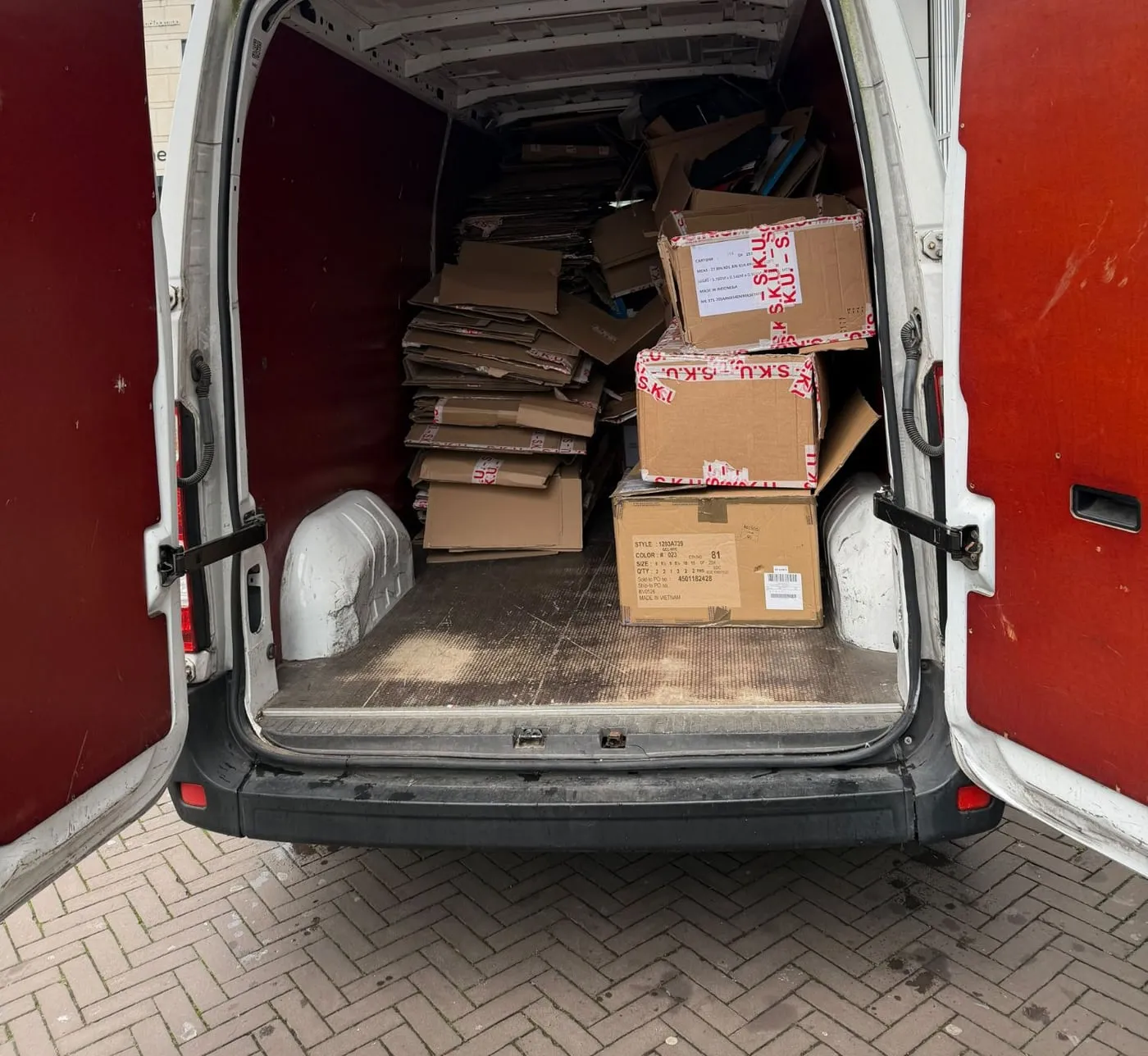
You request a pickup in 1 minute, or send a photo on WhatsApp. You get a fixed price up front. Within 1 to 2 working days we collect the boxes, preferably before opening time and within the loading hours for your street. One-off or recurring by appointment, with disposal at an approved recycling point.
01Why does a shop or restaurant produce so much cardboard?
Almost everything a shop, café or restaurant buys in arrives in cardboard. Every delivery adds another pile of boxes that has nowhere to go.
A clothing shop gets its new collection in large outer boxes. A local supermarket receives roll cages full of trays and boxes several times a week. A café gets kegs, but also boxes of soft drinks, napkins and cups. A restaurant gets its vegetables in crates, but its dry goods, takeaway packaging and cleaning products in cardboard.
Around seasonal changeovers and the holidays, it builds up fast. A shop on a busy street in the city centre fills its back room noticeably faster in November and December than in summer. A café that opens its terrace in spring gets all its new stock in a single week.
The cardboard itself isn't the problem. The problem is that an Amsterdam shop or restaurant has hardly any room to store it until it can go. That's why it pays to have your cardboard picked up at a fixed moment, before it gets in your way.
A typical scenario: a lunch spot in De Pijp takes its big deliveries on Monday and Thursday. By Thursday afternoon, the whole week's boxes are stacked in the little corridor to the cold store. Staff squeeze past with full trays right in the middle of the lunch rush.
02Can a shop or restaurant put cardboard in the street paper bin?
No, cardboard from your business is commercial waste and isn't allowed in the city's household containers. You need to have it collected or removed by a collection service.
Shopping streets have underground paper containers for the people who live above the shops. It's tempting to stuff your boxes in there quickly after closing time. But you'd be using a facility meant for households, and the containers fill up before the neighbours can use them. Check the City of Amsterdam's website for the current rules for business owners.
Leaving boxes next to a full container causes problems too. Loose boxes blow away, get wet and look untidy right in front of your own shopfront. They can also often be traced back to your business through a sticker or a delivery note.
The solution is simple: gather the cardboard indoors and have it picked up. If you'd like to know what other options there are, read where to dispose of cardboard in Amsterdam. For offices and webshops, we have a separate page on business cardboard collection.
03When do we collect the cardboard: before opening time?
Preferably, yes. Collecting before opening time means your customers don't notice a thing and the back room is clear when the day begins.
A shop often opens around ten, a lunch spot earlier and a restaurant not until late afternoon. We plan the pickup for when the place is still closed or quiet. That way no customers are in the way, and your staff don't have to stop what they're doing to help.
For restaurants and bars that open in the evening, the morning or early afternoon is often ideal. The kitchen isn't in full swing yet, and the boxes from that morning's deliveries can go straight away. Let us know in your request when someone will be there to let us in.
We come round within 1 to 2 working days of your request. We agree the exact time with you in advance, so you know exactly where you stand.
If you work in shifts, let a keyholder or regular contact person know we're coming. Ideally, put the cardboard in the agreed spot the evening before. Then we're done in a few minutes, and the van isn't parked on your street any longer than necessary.
04How do we deal with loading hours on Amsterdam shopping streets?
We take the delivery time windows and loading rules on your street into account. That's why we plan the pickup together with you, and as early in the day as possible.
In the city centre and on many busy shopping streets, heavier vehicles are only allowed in at certain times. There's a low-emission zone, and loading bays are scarce. A shopping street that's packed with pedestrians during the day is often only accessible for a quick stop early in the morning. Check the City of Amsterdam's website for the current rules.
That's why we want to know in advance how your premises can be reached. Is there a back entrance, an alley or a loading spot round the corner? Do we need to come through the front door? Are you on a canal where the van can only stop briefly? The better we know this, the faster the pickup goes.
Our page on cardboard collection in Amsterdam city centre explains how we work in the narrow streets of the old town. Outside the centre, on shopping streets in West, Oost or Zuid, access is usually easier, but loading and unloading at busy times can still be tricky there too.
If your business is in a shopping centre or covered arcade, the building manager's rules for the loading area often apply. Ask for them in advance and pass them on to us, so we turn up at the right entrance at the right time.
| Question | Why it matters |
|---|---|
| Is there a back entrance or rear access? | Then the boxes don't have to go through the shop or dining room |
| Where can the van stop briefly? | A short walking route saves time and disruption |
| Are there delivery time windows on your street? | Then we plan within that time slot |
| Is the cardboard on the ground floor, in the basement or in the attic? | Stairs are factored into the fixed price |
| Who lets us in, and at what time? | That way we can come before opening time |
05Why must the fire exit be kept clear of boxes?
Cardboard stacked by a fire exit or in an escape route blocks the way out and is flammable on top of that. A clear escape route is a basic requirement for any business open to the public.
In many Amsterdam shops and restaurants, the back room doubles as storage, a staff changing area and the route to the fire exit. A pile of boxes put in the corridor for a moment grows into a wall within a few days. In an emergency, customers and staff need to get past quickly.
Dry cardboard also catches fire easily. In a kitchen with open flames, a deep fryer or next to electrical equipment, that's an extra risk. So keep cardboard away from heat sources, and don't store it in the meter cupboard or next to the fuse box.
Regular collection is the simplest way to keep your escape route clear. With a fixed collection day, nobody has to think about when the boxes need to go.
- Choose a fixed spot for cardboard that doesn't block a door, corridor or staircase
- Keep stacks of flattened boxes low and stable
- Keep cardboard away from hobs, deep fryers and heaters
- Have cardboard collected before the stack outgrows its agreed spot
06What should you do with greasy or wet cardboard from a kitchen?
Clean, dry cardboard recycles well; greasy or soaked cardboard much less so. That's why it pays to keep food-contaminated cardboard separate from clean cardboard.
A restaurant kitchen produces every kind of cardboard. The outer box from a delivery of dry goods is clean. A box that held fish or meat on ice is wet. Pizza boxes and boxes with oil or grease stains are contaminated. Contaminated cardboard gets in the way of recycling, because grease and food scraps damage the paper fibres.
Wet cardboard is also much heavier than dry cardboard and quickly goes limp. It attracts pests and starts to smell if it's left for a few days. For hygiene reasons, that's not something you want near your kitchen.
Our advice: keep a separate spot for clean, dry cardboard and flatten it. Cardboard with food scraps or grease belongs with your business's general waste. Not sure about a particular batch? Send a photo on WhatsApp. To find out what happens after the pickup, read what happens to collected cardboard.
| Type of cardboard | Can it go? | Notes |
|---|---|---|
| Outer boxes from dry goods and drinks | Yes | Flatten and keep dry |
| Boxes from napkins, cups and takeaway packaging | Yes | Remove plastic film and other plastic |
| Trays from cans and bottles | Yes | Remove shrink wrap |
| Slightly damp boxes from vegetables | By arrangement | Let them dry first if you can |
| Soaked boxes from fish or meat on ice | No | Belongs with your business's general waste |
| Cardboard with grease or food scraps, such as pizza boxes | No | Contaminated cardboard gets in the way of recycling |
07How do you organise a small storeroom for cardboard?
Flatten every box straight after unpacking and put it in one fixed spot. That way, a few deliveries' worth fits into a small corner.
Behind an Amsterdam shop or in a restaurant basement, space is tight. You often share it with stock, cleaning supplies and the refrigeration. An unfolded box takes up many times the space of a flat one. So agree with your team that every box gets flattened as soon as it's empty.
Use a fixed spot against a wall, for example between two shelving units. You can tie large stacks together with string, which makes them easier to carry. Avoid a damp basement: cardboard turns soft and heavy down there.
A typical scenario: a neighbourhood shop in the Jordaan has a back room of just a few square metres. After two deliveries, the door to the toilet is half blocked. With a fixed collection day on Tuesday morning, the day after the big delivery, that room stays clear. You'll find more tips in how to prepare cardboard for pickup.
08One-off or recurring collection for your business?
If you have a fixed delivery day, recurring collection by appointment works best. For a peak, such as a refurbishment or seasonal changeover, choose a one-off pickup.
Most shops and restaurants have a fixed delivery schedule. It makes sense to link the pickup to it, for example the day after the biggest delivery of the week. You set up a recurring arrangement with us that you can adjust when things get quieter or busier. Our page on weekly cardboard collection explains how that works.
A one-off pickup suits an opening, a refit or a big clear-out. If your premises are being refurbished, also read about renovation cardboard removal. If you also end up with lots of plastic film, polystyrene or void fill alongside the cardboard, see packaging waste collection.
Either way, you don't need your own container on the pavement. On an Amsterdam shopping street, that's often not possible anyway. Read more about the cardboard skip alternative.
| Type of business | Typical cardboard pattern | Approach that often works |
|---|---|---|
| Clothing shop or boutique | Peaks with each new collection | One-off at every collection changeover |
| Local supermarket or specialist shop | Several deliveries a week | Recurring on a fixed day |
| Café or coffee bar | Weekly boxes of drinks and cups | Recurring, for example every week |
| Restaurant | Daily deliveries, some wet cardboard | Recurring, with clean cardboard kept separate |
| Business being refurbished or opening | Lots of boxes all at once | One-off pickup after completion |

09How does booking work, and what does collection cost?
You book in 1 minute through the form or WhatsApp and get a fixed price up front. The price depends on the amount and the situation at your premises.
In the form, you tell us what needs collecting, roughly how much, the address and your preferred day. Also add the name of your business for the invoice, and whether we need to come before opening time. Request your pickup in 1 minute or send a photo on WhatsApp to 085 115 0200 (+31 85 115 0200 from abroad).
The fixed price is based on the amount of cardboard, the floor, whether there's a lift and the distance to the van. A basement with a steep staircase, or premises in the middle of a pedestrian zone, means more carrying than a shop with a back entrance next to a loading bay. You always know the price before we arrive.
Kartonophalers is a paid service. We don't buy cardboard, and it isn't a free collection. You pay for the carrying, the transport and the disposal at an approved recycling point. Prefer email? You can reach us at info@meubelophalers.nl.
10Which Amsterdam shopping areas do we cover?
All districts of Amsterdam and the towns right around the city. From the busy shopping streets in the centre to neighbourhood shops, cafés and restaurants across the city.
We collect in Centrum, Zuid, West, Oost, Noord, Nieuw-West and Zuidoost. Think of the big shopping streets in the old town, the markets and shopping streets in De Pijp and Oud-West, the cafés and restaurants around the squares in Oost, and the shopping centres in Nieuw-West and Zuidoost. We also drive to Amstelveen, Diemen, Badhoevedorp, Zaandam, Hoofddorp, Ouderkerk aan de Amstel and Duivendrecht.
Every location needs its own approach. In the old town, it's about delivery time windows and narrow alleys. A shopping centre often has a central loading area with the building manager's own rules. For a café on a square, it's mostly about the right moment, before the terrace is set up.
Want to know who'll be coming to your premises? Kartonophalers is part of the team behind Meubelophalers, the company we are part of, with 1,650+ happy customers. Read more about us or see how the service works in general on cardboard collection in Amsterdam.


